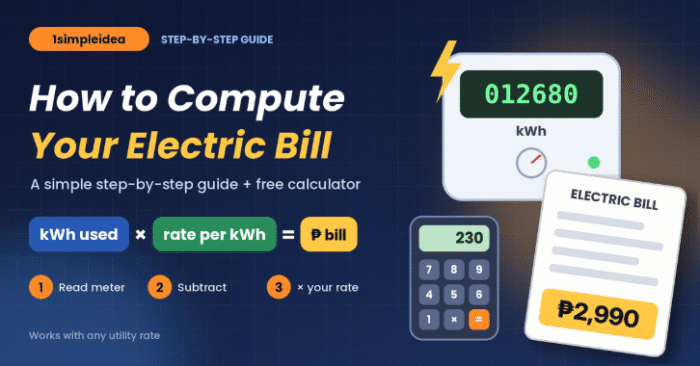
Your electric bill looks complicated, but the core math is simple: how many kilowatt-hours (kWh) you used × your rate per kWh. In this guide you’ll learn how to read your meter, compute your consumption, and estimate your bill in pesos, with a free calculator you can use every month.
In this article
- What is a kWh?
- Step 1: Read your electric meter
- Step 2: Compute your consumption
- Step 3: Find your rate per kWh
- Step 4: Use the electric bill calculator
- Worked example
- Track your daily usage to avoid bill shock
- Common mistakes when computing a bill
- How to lower your next bill
- What else appears on your bill?
What is a kWh?
A kilowatt-hour (kWh) is the unit your utility uses to measure electricity. One kWh is the energy used by a 1,000-watt appliance running for one hour. A 100-watt TV running for 10 hours also uses 1 kWh. This is why both power (watts) and time (hours) matter on your bill.
The basic formula is:
kWh = (watts × hours used) ÷ 1,000
Bill ≈ kWh × rate per kWh
Step 1: Read your electric meter
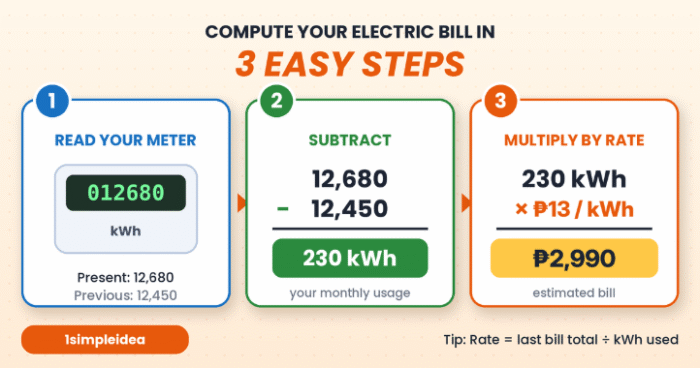
Most homes have either a digital meter or an older dial meter. Both show a running total of kWh used since the meter was installed. To know your monthly usage, you need two readings: the previous reading (last billing date) and the present reading (today).
- Digital meter: read the number on the display labeled kWh. Ignore decimals unless your bill uses them.
- Dial meter: read each dial from left to right. If a pointer is between two numbers, take the lower number.
Your bill usually prints the previous and present readings, so you can check that the utility read your meter correctly.
Step 2: Compute your consumption
Subtract the previous reading from the present reading:
Consumption (kWh) = Present reading − Previous reading
Example: if last month’s reading was 12,450 and today’s reading is 12,680, you used 230 kWh. Some meters use a multiplier (common in commercial buildings). If your bill shows a multiplier, multiply your consumption by it.
Step 3: Find your rate per kWh
Your rate per kWh is the total peso amount charged for each kWh. It is made up of several parts, such as generation, transmission, distribution, system loss, taxes and other charges. Rates change every month because fuel prices, power supply and exchange rates change. The easiest way to get your effective rate is:
Effective rate = Total bill ÷ kWh consumed
For example, a ₱3,000 bill for 230 kWh means an effective rate of about ₱13.04 per kWh. Use your own number in the calculator below, because rates differ by utility, location and month.
Step 4: Use the electric bill calculator
⚡ Electric Bill Calculator
Worked example
| Item | Value |
|---|---|
| Previous reading | 12,450 kWh |
| Present reading | 12,680 kWh |
| Consumption | 230 kWh |
| Rate | ₱13.00 per kWh |
| Estimated bill | ₱2,990.00 |
Your actual bill may differ slightly because of fixed charges, lifeline discounts, senior citizen discounts, adjustments or arrears from previous months.
Track your daily usage to avoid bill shock
You don’t have to wait for the bill. Read your meter at the same time every day for a week. The difference between two days is your daily kWh. Multiply it by 30 to predict your month. If one day is much higher, think about what was different that day: did the aircon run longer, or did you iron clothes or do laundry?
- Under 5 kWh/day: a light-use household (fans, LED lights, TV, ref).
- 5 to 10 kWh/day: typical with a ref, TV, laptop and some aircon use.
- Over 10 kWh/day: aircon, water heater or several big appliances are likely running daily.
Common mistakes when computing a bill
- Using the wrong rate. The rate changes monthly, so update it every bill.
- Forgetting the multiplier. Some meters need it, and skipping it makes your estimate far too low.
- Reading dials incorrectly. When a pointer is between numbers, always take the lower one.
- Ignoring previous balances. Unpaid amounts and adjustments are added to your total.
How to lower your next bill
Once you know your kWh, you can attack the biggest users first. Cooling (aircon), heating (water heater, flat iron) and always-on appliances (ref, freezer) usually take the biggest share. Set your aircon to around 24–25°C, use a timer, replace old incandescent bulbs with LED, and unplug appliances that you don’t use.
What else appears on your bill?
Besides the energy charge, your bill may show separate lines. Knowing them helps you understand why the total isn’t always exactly kWh × rate:
- Generation charge: the cost of producing the electricity, usually the biggest part.
- Transmission charge: the cost of moving power through high-voltage lines.
- Distribution, supply and metering charges: the local utility’s cost to deliver power to your home and maintain meters.
- System loss: the cost of electricity lost along the lines.
- Taxes and other charges: VAT, local taxes and government-mandated charges or subsidies.